|
Andy Warhol
Hot on the heels of Yves Klein's media awareness, the idea of Warhol's approach would be to (ostensibly) politically subvert the symbology of mass consumption in a way which does not so much theaten the 'system' so much as co-opt it or build on top of it. Warhol's characteristically cagey responses to questions about his work do not get us any closer to the truth. Was he simply being playful, hiding a guilty truth or was it simply that he did not understand such relationships as they were purported to exist. Below, we look at some of his more typologically sound works and dig a little bit deeper. Despite what guilt we may asign him, Warhol can indeed be credited with advancing the common view not only of advertising symbols, but also of the reframing of photography, printing and the general cooption of commercial and industrial memes into the artist's palette. Prime examples of this are the liberation of the news wire photograph used in his disaster series, the autopsy of the screen printing process employed in his 'Marilyn' and celebrity silk screen prints - and the general 'opening' up of something thought to be the exclusive province of the industrial - in very much the same way that Frank Gehry might be credited with doing with architecture twenty years later (co-opting industrial building sytaxes on behalf of home dwellers). Groundbreaking though they were, Warhol's machinations can also be seen as being as 'guilty' of the very same crimes that the work purports to criticise or subvert. In the end one is not completely sure that one hasn't been hoodwinked. Despite the uneasy relationships, the work endures a timeless symbol of 'the new' and stands to this day to denote 'Pop Art' with as much vigor as anything else possibly can.
|

Andy Warhol,Campbell's Soup I, 1968. |
New Austerity, New Clothes?
The appearance of Andy Warhol (born Andrew Warhola) 'on the scene' was generally considered a harbinger of change - an antidote for, and death knell of - a now-tired Abstract Expressionism in the community of the North American (esp. the 'New York' variety) Avant-Garde. The financial and media support for Warhol's work was unprecedented from the get-go. Very few artists in history have enjoyed the same degree of acceleration from the media especially at the start of their careers. For this reason Warhol became himself as much an icon as the sterile and remote images he offered. In a sense he introduced the self-consciousness of the concepts of branding and celebrity to the western world - by proffering the residue of consumer society back to us in a way nobody had really considered before. And there's the rub where Warhol's concerned.
In Robert Hughes' 1982 article in the New York Review of Books - Hughes' offered the following insight;
“Chauncey Gardiner, the hero of Jerzy Kosinski’s Being There, he came to be credited with sibylline wisdom because he was an absence, conspicuous by its presence - intangible, like a TV set whose switch nobody could find. Disjointed public images - the Cambell’s soup cans, the Elvises and Lizzes and Marilyns, the electric chairs and car crashes, and the jerky, shapeless pornography of his movies - would stutter across the screen; would pour from it in a gratuitous flood. But the circuitry behind it, the works, remained mysterious. “If you want to know all about Andy Warhol,” he told an interviewer in those days, “just look at the surface of my paintings and films and me, and there I am. There’s nothing behind it.” What had become of the belief, dear to modernism, that the power and cathartic necessity of art flowed from the unconscious, through the knotwork of dream, memory, and desire, into realized image? No trace of it; the paintings were all superficies, no symbol. Their blankness seemed eerie.”
Hughes found it conspicuous that someone so invested in commercialization and media vehicles would or could function in a 'subversive' mode - especially someone who would later specialize in creating vanity portraits for the captains of industry and launch the likes of 'Interview' (magazine) - whose existence would testify to Warhol's dedication to the interests of Privelege - to the point of forging himself into the happy instrument of public persuasion.
|
Warhol's Disaster Series
 Andy Warhol, Tunafish Disaster, 1963. Andy Warhol, Tunafish Disaster, 1963.
|
 Andy Warhol, Red Atom Bomb, 1965. Andy Warhol, Red Atom Bomb, 1965.
|
 Andy Warhol, Orange Disaster/ Electric Chair, 1963 Andy Warhol, Orange Disaster/ Electric Chair, 1963
|
 Andy Warhol, Red Disaster/Electric Chair, 1963 Andy Warhol, Red Disaster/Electric Chair, 1963
|
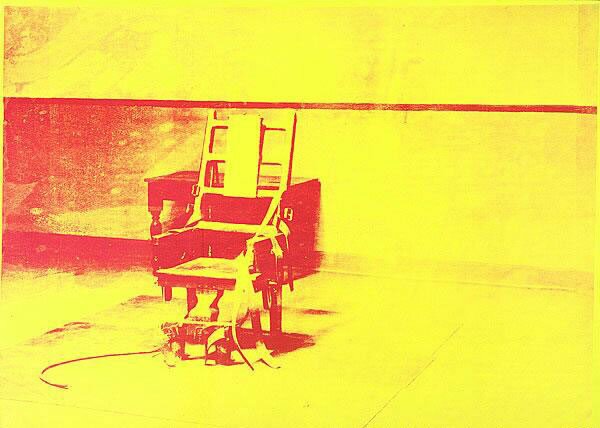 Andy Warhol, Electric Chair, 1967. Andy Warhol, Electric Chair, 1967.
|
|
 Andy Warhol and Gerard Malanga, Homage to Salvador Dali, 1964. Andy Warhol and Gerard Malanga, Homage to Salvador Dali, 1964.
|
 Andy Warhol and Gerard Malanga, The Young Mod (for Jean Shrimpton), 1964. Andy Warhol and Gerard Malanga, The Young Mod (for Jean Shrimpton), 1964.
|
 Andy Warhol and Gerard Malanga, The Model That Models for Buick, 1965. Andy Warhol and Gerard Malanga, The Model That Models for Buick, 1965.
|
 Andy Warhol and Gerard Malanga, That Was All, 1964. Andy Warhol and Gerard Malanga, That Was All, 1964.
|
 Andy Warhol and Gerard Malanga, The Star Structure, 1965. Andy Warhol and Gerard Malanga, The Star Structure, 1965.
|
 Andy Warhol, Five Deaths on Orange, 1962. Andy Warhol, Five Deaths on Orange, 1962.
|
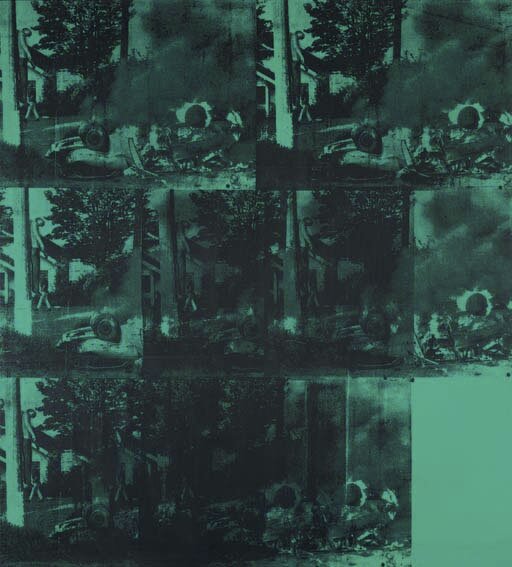 Andy Warhol, Green Car Crash (Green Burning Car I), 1963 Andy Warhol, Green Car Crash (Green Burning Car I), 1963
|
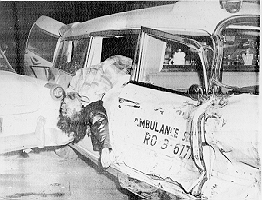 Andy Warhol, Ambulance Disaster, 1963. Andy Warhol, Ambulance Disaster, 1963.
|
 Andy Warhol, 3 frames of White Burning Car III , 1963 Andy Warhol, 3 frames of White Burning Car III , 1963
|
|
written and edited by JWD
|